The sustainability of agricultural ecosystems depends on soil micro-food webs, which are often referred to as the "hidden underground engine" of farmland. Understanding the properties, functions, and interaction patterns of these micro-food webs is crucial for sustainable agricultural management.
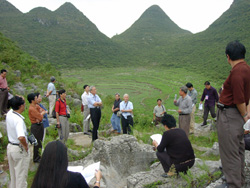
To address this challenge, researchers led by Prof. WANG Kelin from the Institute of Subtropical Agriculture of the Chinese Academy of Sciences conducted a series of investigations to assess the cycling processes of soil carbon, nitrogen, and phosphorus, as well as the community properties, functions, and interaction patterns of belowground biota in karst farmland regions of Southwest China. They also explored the relationships among these factors along a gradient of low to high agricultural management.
The researchers found that, as agricultural intensification increases, the abundance of functional genes associated with soil phosphorus starvation rises, while genes involved in phosphorus solubilization, mineralization, and transport gradually decline. Correspondingly, soil available phosphorus content decreases with greater agricultural disturbance. These results suggest that adopting conservation farming practices, such as planting pasture, can enhance soil phosphorus cycling and alleviate phosphorus limitation. However, microbial involvement in phosphorus cycling is closely linked to carbon and nitrogen cycling processes.
In relatively mild, mid-alkaline calcareous soils, bacterial species are highly abundant, and the carbon and nitrogen cycles proceed more rapidly. This provides ample resources for microbial growth and reproduction, contributing to greater soil organic carbon accumulation. In contrast, fungal species dominate in nutrient-poor, acidic red soils. Here, microbes allocate more energy to survival than growth, which slows down carbon and nitrogen cycling.
The researchers warned that intensive agricultural management may weaken the carbon sequestration capacity of bacteria and slow soil carbon and nitrogen cycling, potentially triggering positive carbon-climate feedback. Beyond microbes, soil also hosts other organisms such as viruses and soil fauna. Their interactions form a complex soil micro-food web, which is expected to significantly influence broader soil functions, including nutrient cycling, water retention, soil structure improvement, and plant disease suppression.
Through the integration of molecular sequencing and field measurements, the researchers discovered that conservation agriculture stabilizes belowground communities. This stability helps maintain high soil functionality, even under environmental stress, thereby supporting sustainable crop yields.
Soil fauna, in particular, can stabilize the entire soil biota community through top-down regulation. This underscores the importance of agricultural practices that protect soil fauna abundance and diversity, in addition to soil microbes.
"Our study on the properties and function of the soil micro-food web under varying soil conditions and agricultural disturbances in karst agroecosystems helps clarify the underground biological mechanisms driving soil functions, especially in the context of global agricultural intensification," said Prof. ZHAO Jie, corresponding author of the study. "This will provide a scientific basis for formulating more sustainable agricultural policies."
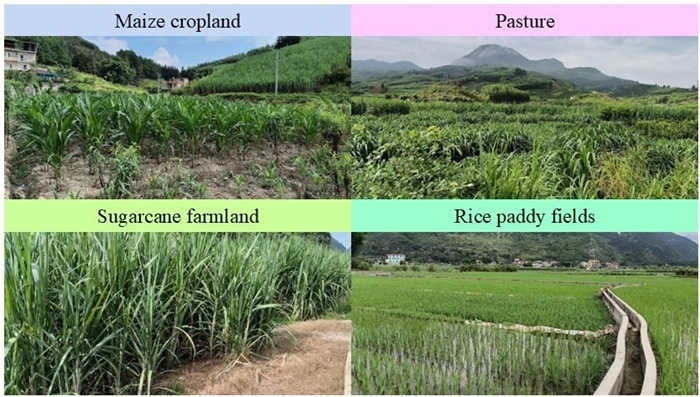
Selected four agricultural land use types in this study (Image by LONG Xianwen)
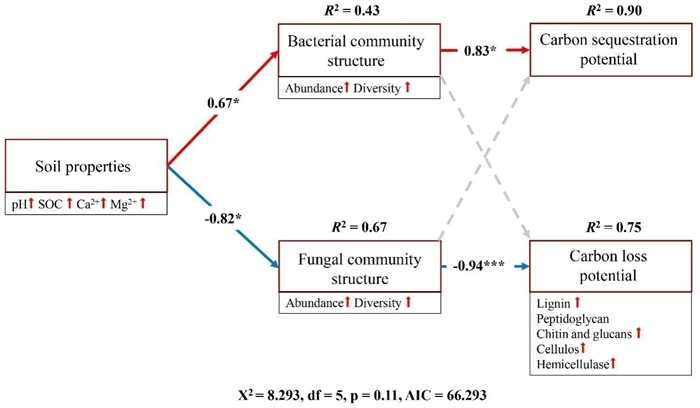
Microbial driving mechanisms of soil carbon sequestration and decomposition potential (Image by LONG Xianwen)

86-10-68597521 (day)
86-10-68597289 (night)

52 Sanlihe Rd., Xicheng District,
Beijing, China (100864)
Copyright © 2002 - Chinese Academy of Sciences